I've been doing a lot of ESRI online courses lately as part of the UNIGIS program, and I have to say - they're really good. There are two basic types of courses offered by ESRI - instructor-led courses and online courses. Being in Ecuador, only the online courses are available to me, though I hope to someday be able to have a live course too.
The online courses are nothing to complain about, though. Lots of useful topics with a good theoretical introduction, often solidifying the basics and then followed by well-explained exercises - a good combination between theory and practice. So far, my favorites are the 3D visualization technique courses and site selection courses.
Sometimes, though, it can be difficult to know the best order to take them in, and then I end up doing a more advanced course first or repeating some topics, but that's not such a big problem. After all, repetitio mater studiorum est!
nedjelja, studenoga 16, 2014
utorak, listopada 07, 2014
Thesis time!
The time has
come to face the final challenge in the UNIGIS Master program: the thesis.
Being an
ecologist, I wanted the work to take into account my interests, both personal
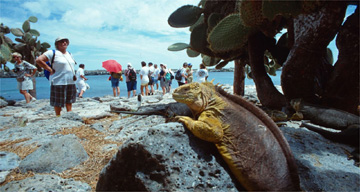
and professional. And, I am currently working on a project regarding the world-famous
Galapagos Islands in Ecuador, so I thought why not combine both. After some
research, I think I found my topic: Identifying terrestrial conservation
priorities in the Galapagos Islands, based primarily on anthropogenic threat assessment.
http://nothingtoloseandaworldtosee.files.wordpress.com
The conservation
of the famed Galapagos Islands experienced two crucial points during its
history: it started officially in 1959 with the creation of the Galapagos
National park, and was later expanded to the marine ecosystem by forming the
Galapagos Marine Reserve in 1996. However, by that time, the archipelago had
experienced severe human influence that first started with the discovery of the
Islands in 1535, intensifying strongly with the beginning of organized
colonization in 1983 and continuing relentlessly ever since. Today, the
Galapagos NP encompasses 96,7% of the islands (7 731 km2) and the Marine
Reserve reaches up to 40 miles from the Islands (138 000 km2), but anthropogenic
influence is still great and poses a significant threat to the conservation
efforts.
The primary
factor of influence is tourism, which has sky-rocketed in the last decades,
causing strong immigration of the Ecuadorean population from the continent,
bringing with it almost complete dependence of energy, food and water from the
continent, and causing a host of problems: introduced and invasive species,
illegal and uncontrolled fishing, contamination of aquifers and soil,
inadequate or (for the most part) inexistent solid waste and residual water
management, rampant urbanization, among others. These factors keep altering the
fragile ecosystems of the Galapagos Islands, despite the constitutional
protection that Pacha Mama (Mother Nature) enjoys in Ecuador and the continuous
efforts of the NP and Marine Reserve management.
http://static.guim.co.uk/sys-images/Travel/Pix/pictures/2006/04/19/galapagos360.jpg
Despite the
strong scientific interest in Galapagos, there have been few attempts to
quantify the anthropogenic influences suffered by the ecosystems. However, it
is precisely by means of a thorough evaluation of human risk factors risk that
conservation of the Islands should be managed, in order to aim its valuable and
costly efforts into particular human activities, specific areas and species.
The objective of
the project will be to perform an ecological risk assessment for terrestrial
conservation in the Galapagos Islands based on anthropogenic risk factors, and
identify areas that represent conservation priorities.
So… the next
step is to gather all the information available in order to identify, quantify
and spatially delimit the influences that the terrestrial ecosystems of
Galapagos face due to various human activities, and also to identify and
localize the distribution of target terrestrial species on the islands. With that,
it will be possible to identify areas that require particular conservation
efforts, based on an overlay of quantified threats and identified species, and
finally to produce a map of conservation priority areas.
So now cross my
fingers and start working…
nedjelja, kolovoza 03, 2014
Map apps galore
My last blog entry made me want to take a loser look on map apps for
smartphones. I have a Sony Xperia so Android app store on Google Play is the
basic investigation tool for this task.
So far I have been using Maps and My Tracks, both developed by Google,
and I consider them sort of basic types of map apps for any novice user. And what I consider essential is that you can use
both offline, so even if you don’t have internet access at all times, you can
still use these apps to figure out where you are.
Maps is just like Google Maps that we all access online to search for a specific street, address or business. Their maps are very accurate and the layers available are satellite, terrain, traffic, etc. You can use as Maps a simple and effective navigation tool, search for near-by business and depending on your location in the world, there are live traffic updates and Street View options available.
Maps

My Tracks app is excellent for recording your path, speed, distance, and elevation during any outdoor activity – I’ve tried it during bus rides, cycling and walking and it works perfectly. You can add notes at certain points, view statistics and hear periodic voice announcements of your progress. Your track can be synced on Google Drive and shared with other Google users.
My Tracks
There’s another nice little free app that a lot of outdoorsy people like
to use, the MapMyRide. It offers the standard services of mapping your route
and tracking the activity type, but it can also keep track of the foods you eat
so as to accurately calculate your calorie output.
MapMyRide calorie counter
Then you can go ahead and share your route with your friends and look
for interesting routes posted by others in your area or anywhere else you’re planning
to visit. A highly recommended app.
A route shared through MapMyRide
There seems to be countless map apps out there, just go ahead and invest a couple of days to try out a few and see which one suits your needs the best. And have fun!
četvrtak, lipnja 26, 2014
Mobile GIS
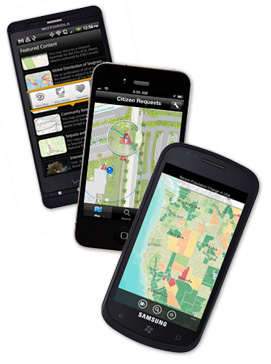
Mobile technologies keep growing in capabilities, diversity and availability by the week. The decreasing prices of mobile devices and mobile services, better coverage and new software have made it one of the most dynamic services today - so no wonder that mobile GIS applications are getting more and more popular, both in the professional world and with the average outdoor enthusiast.
Being free from desktop hardware has many advantages. The user can easily use relatively cheap smartphones or tablets to access maps, collect and report data and even perform analysis. The software client interface is usually simpler, the costs of data collection can be greatly reduced and the data can be quickly synchronized with the client’s servers.
However, mobile technology has
some drawbacks as well. The small screen size of smartphones, short battery
life, limited keyboard functionality and limited processing power are some of
the most common shortcomings of mobile GIS.
Nevertheless, most professional GIS
software companies, such as ESRI and Google, are investing in this quickly
developing market, constantly developing their mobile and online services. But
there are also many start-ups and web communities that are developing their own
mobile GIS solutions, that may be more easily adapted to personal users or
small business needs. There are services that are available online and offline
so not even a remote location is out of reach.
utorak, lipnja 10, 2014
ArcGIS Online, a map service for everyone
While working on the latest module of the UNIGIS master
course, I am beginning to get acquainted with various online map services. One
of the more interesting ones is the ArcGIS Explorer Online, available at http://www.arcgis.com/explorer.
The website offers many interesting user-made theme maps,
such as World AIDS Day Map, Import and Export of Plastic Waste, Forest Areas in
Europe, etc. These maps can serve as a good starting point or illustration for
a student investigation or visual information for the interested public.
But the real benefit of this map service is the ability to
create (and publish) one’s own theme map. The ArcGIS Explorer offers base maps
where a user can easily add information of interest, explore overlays and see
associated data. You can look for information shared by other users based on keywords, import your own data or use your previously stored information.
In this way, the user can explore publicly available or
personal data without the need for a professional and expensive software, and
what is more, share this information with people he/she chooses or publish it
for everyone to access.
For example, I investigated the occurrence of wildfires in the United States and produced a map that can be accessed here. It is fun and easy, really a tool for everyone.
Pretplati se na:
Postovi (Atom)
I may not have gone where I wanted to go, but I'm sure I ended up where I needed to be.